LILYGO T-Display K230 RISC-V AI dev kit features AMOLED, LoRa, and keyboard with optional LTE-M/NB-IoT cellular connectivity
AI Analysis Abstract The LILYGO T-Display K230 is a handheld development kit built around the Canaan Kendryte K230 dual-core 64-bit RISC-V processor, which includes an integrated AI accelerator. It features a 4.1-inch AMOLED touchscreen, 1GB LPDDR4 RAM, a 2MP camera, and…
AI Analysis
Abstract
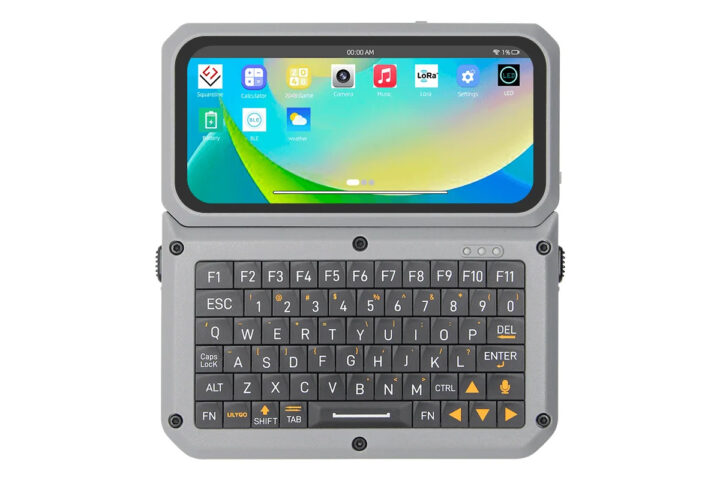
The LILYGO T-Display K230 is a handheld development kit built around the Canaan Kendryte K230 dual-core 64-bit RISC-V processor, which includes an integrated AI accelerator. It features a 4.1-inch AMOLED touchscreen, 1GB LPDDR4 RAM, a 2MP camera, and comprehensive connectivity options such as LoRa, WiFi 4, Ethernet, and HDMI output. The kit supports an optional detachable keyboard that provides additional battery capacity and optional LTE-M/NB-IoT cellular and GNSS connectivity, making it suitable for a range of embedded, AI, and communication-focused applications.
Key Highlights
- Handheld development kit featuring a 4.1-inch AMOLED touchscreen.
- Powered by a dual-core 64-bit RISC-V Kendryte K230 processor with an integrated AI accelerator.
- Offers diverse connectivity options including LoRa, WiFi 4, and Ethernet.
- Supports an optional detachable keyboard providing battery power and optional LTE-M/NB-IoT cellular and GNSS capabilities.
- Includes comprehensive software support with a Linux SDK and RT-Smart firmware.
Technical Details
- SoC: Kendryte K230 with dual 64-bit RISC-V cores (1.6GHz with RISC-V Vector Extension 1.0, FPU; 800MHz with RV64GCB instruction set).
- AI Accelerator: KPU supporting INT8 and INT16, compatible with TVM, TensorFlow, PyTorch, ONNX (e.g., Resnet 50 "u2265" 85fps @ INT8; Mobilenet_v2 ",u2265" 670fps @ INT8; YoloV5S ",u2265" 38fps @INT8).
- Graphics/Video: 2.5D GPU, 3D DPU, and hardware H.264/H.265 video encoding and decoding VPU.
- Memory: 1GB LPDDR4 RAM.
- Display: 4.1-inch 568 ",u00d7" 1232 AMOLED display with RM69A10 driver and GT9895 touch controller via MIPI DSI.
- Camera: 2MP GC2093 camera supporting 1080p resolution, with a rotatable module and up to three MIPI CSI interfaces on the uncased board.
- Connectivity: WiFi 4 (RTL8189, 802.11b/g/n, 2.4GHz), LoRa (Semtech SX1262 or LR2021 transceiver), 10/100Mbps Ethernet (RTL8152B controller), 2x MMCX antenna connectors.
- I/O: HDMI port supporting up to 1080p30, 3x USB Type-C ports (for power, USB OTG, and nRF52840 debugging), MicroSD card slot, 3.5mm headphone jack, built-in microphone and speaker (MAX98357A I2S audio amplifier).
- Expansion: 40-pin GPIO header, Qwiic I2C interface, 24-pin docking connector for optional keyboard.
- Optional Keyboard: Features a backlit QWERTY keypad (TCA8418 controller, XL9555 GPIO expander), two 21700 battery holders with BQ25896 charging IC and BQ27220 fuel gauge, and an optional Nordic nRF9151 SiP for LTE-M, NB-IoT, and GNSS connectivity with a SIM card slot.
- Software: Kendryte K230 Linux SDK, CanMV/RT-Smart firmware, LVGL-based launcher with applications for camera, video, audio, LoRa, WiFi, and battery monitoring. Experimental Meshtastic and LoRaWAN support is also available.
Implications
- The integrated AI accelerator and Linux-capable RISC-V processor enable the development of advanced AI and machine learning applications in a portable form factor.
- Diverse communication options, including LoRa, WiFi, Ethernet, and optional cellular/GNSS, support a broad spectrum of IoT, remote monitoring, and wireless communication projects.
- The handheld design with an AMOLED display and optional keyboard facilitates interactive embedded applications and supports on-the-go development or deployment scenarios.
- Hardware video encoding/decoding capabilities and camera support allow for applications requiring real-time video processing, surveillance, and streaming.
- The comprehensive software support and available source code provide a flexible platform for developers to customize and extend functionality.
Limitations
- Several advanced features, including cellular connectivity (LTE-M/NB-IoT), GNSS, Bluetooth LE, and additional battery capacity, are only available through the optional keyboard expansion board.
- The specific LoRa transceiver model (Semtech SX1262 or LR2021) varies depending on the kit's configuration.
- Meshtastic and LoRaWAN support is explicitly stated as experimental, indicating potential for instability or incomplete functionality.
- The AHT20 temperature/humidity sensor and nRF52840 GPIO expansion header are only present on the cased version of the device.