SPEC CPU2026 Under the Microscope: Programs, Phases, and Samples
AI Analysis Abstract This paper provides a detailed characterization of the SPEC CPU2026 benchmark suite across three levels: program, phase, and sample. The authors analyze whole-run metrics, compiler and platform sensitivity, and top-down bottlenecks on x86, Arm, and RISC-V…
AI Analysis
Abstract
This paper provides a detailed characterization of the SPEC CPU2026 benchmark suite across three levels: program, phase, and sample. The authors analyze whole-run metrics, compiler and platform sensitivity, and top-down bottlenecks on x86, Arm, and RISC-V architectures. They reveal that whole-run averages often obscure significant time-varying behavior within benchmark executions, classifying inputs into steady, multi-phase, and bursty categories. Critically, the study validates the widely used SimPoint sampled simulation method against hardware measurements, demonstrating its inaccuracy for non-steady inputs and high sensitivity to random seeds. The findings indicate that SimPoint's primary limitation lies in its selection of representative intervals rather than its clustering mechanism, leading to practical recommendations for more accurate sampled simulation of CPU2026.
Key Highlights
- Program-level analysis shows integer benchmarks are often frontend bound, while floating-point benchmarks are frequently memory bound, with compiler versions capable of halving or nearly doubling individual benchmark IPC.
- Phase-level characterization reveals that over half of the SPECrate inputs exhibit time-varying behavior, with IPC varying by more than an order of magnitude within a single input run.
- SimPoint, a common sampled simulation tool, is accurate for steady inputs but shows errors up to 43% on multi-phase and bursty inputs, and its accuracy can vary by 58 percentage points due to random seed changes.
- The root cause of SimPoint's inaccuracy is identified as the selection of representatives, not the clustering, as an oracle selection method reduces error to within 2.6% for all inputs.
- Practical recommendations are provided for using SimPoint with CPU2026, including pre-classifying inputs by phase behavior and running multiple random seeds for non-steady workloads.
Technical Details
- The study characterized SPEC CPU2026 on three platforms: Intel Sapphire Rapids (x86), Graviton4 (Arm), and SpacemiT K3 (RISC-V), using GCC 15.2.0 and GCC 13.3.1 compilers.
- Hardware counters were measured at whole-run, 10ms, and 100 million instruction intervals to capture program behavior at different granularities.
- For the program-level analysis, the authors reported whole-run metrics for all 52 benchmarks and classified them by dominant top-down bottlenecks (frontend, bad speculation, memory, core, or balanced).
- Workload scaling analysis showed that 'train' workloads, while smaller, often do not accurately represent 'ref' workloads for cache and branch behavior, despite similar average IPCs.
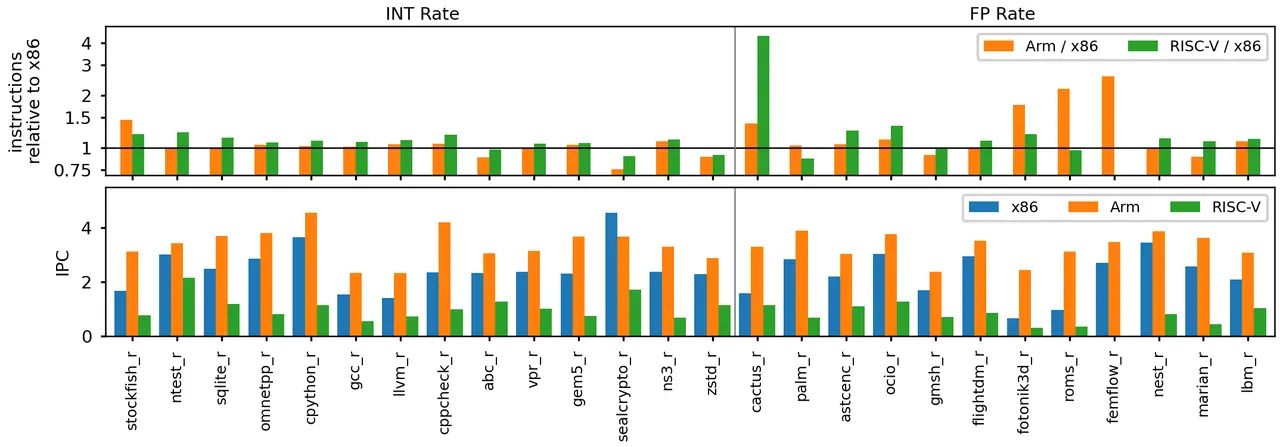
- Cross-platform comparisons revealed that Arm and RISC-V platforms executed 25% more instructions on average than x86 for floating-point benchmarks, making per-instruction metrics less comparable.
- Phase-level characterization of 90 SPECrate inputs on x86 classified them as steady (38 inputs), multi-phase (35 inputs), or bursty (17 inputs) based on IPC variation and slow interval time share.
- Slow intervals (IPC below 0.3) were found to take significantly more run time than their instruction share, with ratios ranging from 3.0 to 59 for some inputs.
- SimPoint 3.2 was validated against per-interval hardware CPI measurements, with default settings (K up to 30 clusters) and across five random seeds.
- An oracle experiment, replacing SimPoint's representatives with the cluster member closest to the cluster's cycle-weighted CPI, reduced the maximum error to 2.6%.
Implications
- Computer architecture researchers should be cautious when relying solely on whole-run average metrics for SPEC CPU2026, as they can mask significant time-varying behavior critical for accurate evaluation.
- Using smaller 'test' or 'train' workloads as proxies for 'ref' in detailed simulation studies, especially for memory hierarchy or branch prediction, can lead to inaccurate conclusions due to differing behaviors.
- The choice of compiler significantly impacts benchmark performance and instruction count, meaning IPC values from studies using different compilers are not directly comparable.
- SimPoint's unreliability for multi-phase and bursty benchmarks necessitates a more robust sampling strategy, as a single run with default settings can yield highly variable and inaccurate results.
- The findings highlight the need for improved representative selection mechanisms in sampled simulation tools like SimPoint, potentially by incorporating performance metrics alongside code signatures during clustering.
Limitations
- The cross-platform comparison of instruction count and IPC does not differentiate between differences arising from the Instruction Set Architecture (ISA) and those from the microarchitecture.
- The phase classification thresholds (e.g., 1.3x IPC ratio for steady, 2% slow interval time share for bursty) are heuristic, although sensitivity analysis indicated robustness.
- The sampling study focused exclusively on single-threaded SPECrate benchmarks and SimPoint, thus its conclusions may not extend to multi-threaded applications or other sampled simulation methods.
- The validation of SimPoint used hardware measurements as ground truth to isolate sampling error from simulator modeling error, but did not involve full cycle-level simulations.
- One benchmark, 766.femflow_r, failed to compile on the RISC-V platform, resulting in incomplete coverage for RISC-V results.
- The study's findings are specific to SPEC CPU2026 and the tested hardware/compiler configurations, and may not generalize to other benchmark suites or system setups.
Source: https://arxiv.org/abs/2611.16376