Agentic AI for Heterogeneous System Design Across Chip, Scale-Up, and Scale-Out Domains
AI Analysis Abstract Modern AI and High-Performance Computing (HPC) systems face a rapidly expanding and complex design space, encompassing diverse compute architectures like GPUs, dataflow processors, and RISC-V accelerators, various memory technologies, and multiple…
AI Analysis
Abstract
Modern AI and High-Performance Computing (HPC) systems face a rapidly expanding and complex design space, encompassing diverse compute architectures like GPUs, dataflow processors, and RISC-V accelerators, various memory technologies, and multiple interconnects. Given that no single architecture excels across all workloads (LLM training, serving, AI-coupled HPC), manual exploration of this combinatorial space is impractical. This paper introduces ArchAgent, a hierarchical multi-agent framework utilizing an LLM-based planner to break down system design into chip, scale-up, and scale-out subproblems, each managed by specialized agents. A deterministic analytical evaluator provides performance estimates, preventing LLM-generated performance claims. ArchAgent demonstrated a 1.93x weighted geometric mean speedup over a homogeneous GPU baseline for a mixed AI+HPC workload under a 1 MW power budget, achieving this with significantly fewer evaluations (18) compared to hill climbing (100 evaluations for 1.65x speedup).
Key Highlights
- ArchAgent is a hierarchical multi-agent framework for heterogeneous system design, leveraging LLM-based planning and specialist agents.
- A deterministic analytical evaluator provides all performance estimates, ensuring auditability and preventing LLM-generated performance claims.
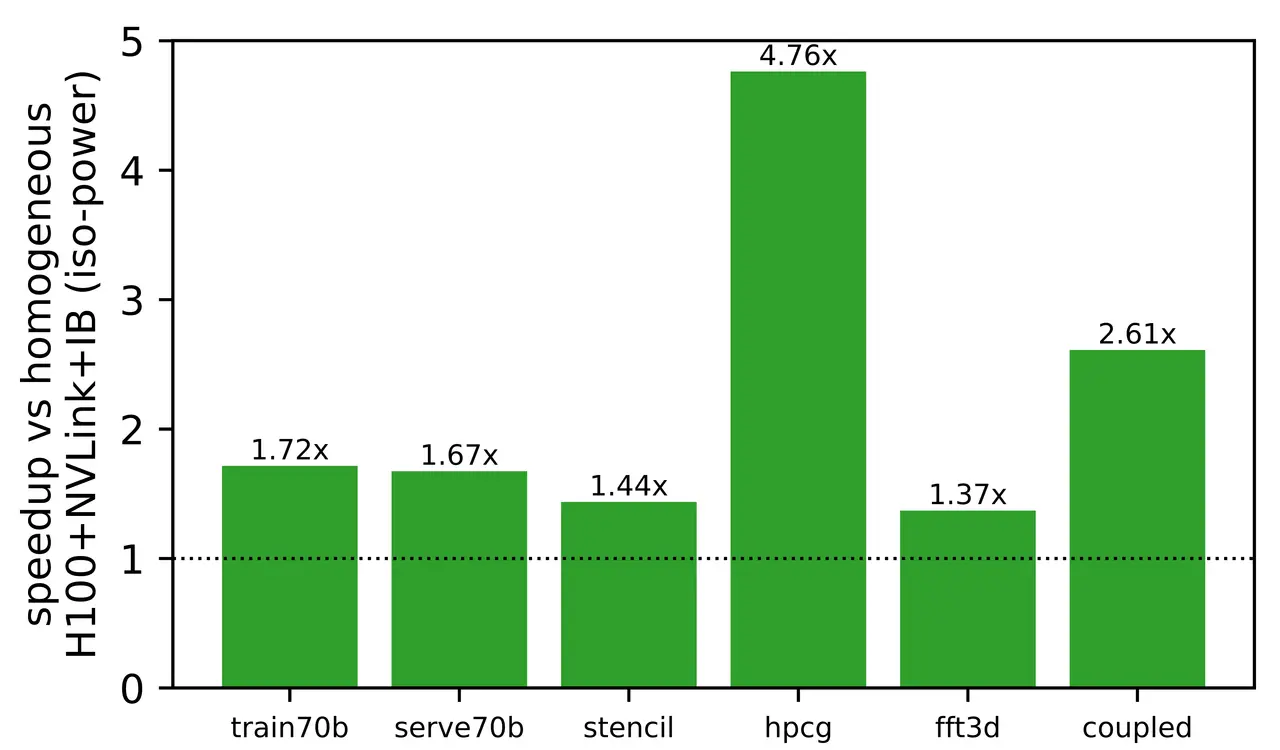
- ArchAgent achieved a 1.93x weighted geometric mean speedup over a homogeneous GPU baseline for mixed AI+HPC workloads under a 1 MW power budget.
- The framework demonstrated superior search efficiency, discovering high-quality designs in 18 evaluations compared to 100 for hill climbing.
- Discovered heterogeneous designs often feature a large GPU-like partition complemented by smaller, role-specialized dataflow and FP64 partitions.
- The design space explored includes RISC-V accelerators, alongside GPUs and dataflow processors.
- Key performance bottlenecks identified in winning configurations are all-to-all communication and FP64 memory bandwidth.
Technical Details
- ArchAgent employs a hierarchical multi-agent framework with a planner agent that decomposes system design into chip, scale-up, and scale-out subproblems, handled by specialist sub-agents.
- System designs are represented as JSON documents specifying partitions, chip archetypes (including RISC-V accelerators like Tenstorrent's Blackhole), scale-up/scale-out fabrics, power allocation, and workload roles.
- The deterministic analytical evaluator uses a roofline formulation for conventional accelerators, pipelined layer sharding for SRAM-resident dataflow architectures, and an α–β formulation for communication costs.
- The model supports LLM training (tensor, pipeline, data parallelism, ZeRO-style memory checks), disaggregated serving (prefill/decode), and four HPC kernels (FP64 stencil, HPCG-like conjugate-gradient, 3D FFT, coupled AI-surrogate–solver loop).
- Model calibration was performed against published MLPerf results and vendor-reported measurements.
- Evaluation methodology uses an iso-power constraint of 1 MW and optimizes a weighted geometric mean of per-workload speedups relative to a homogeneous H100+NVLink4+InfiniBand-NDR reference system.
- A same-generation control experiment was used to isolate the benefits of architectural heterogeneity from generational hardware improvements.
Implications
- Future mixed AI+HPC systems could benefit from scale-out fabrics with higher injection bandwidth (e.g., ≥200GB/s per endpoint) and hardware support for in-network collective and all-to-all communication.
- Memory systems with HBM4-class bandwidth (e.g., ≥10TB/s per socket) or accelerators combining high memory bandwidth with substantial FP64 capability are suggested to address bandwidth-bound HPC workloads.
- System procurement could be organized around workload roles, with specialized heterogeneous components complementing predominantly AI-oriented systems.
- Allocating a small fraction (2–10%) of the power budget to specialized decode or solver partitions can significantly improve overall system performance.
- The ArchAgent framework can serve as a benchmark for studying the impact of open-weight LLM capabilities on hardware-design search tasks due to its auditable and deterministic evaluation process.
Limitations
- The analytical evaluator does not capture switch-level congestion, uses fixed factors for compute/communication overlap, and does not account for KV-cache transfer in disaggregated serving, which may affect communication-intensive configurations.
- The wafer-scale archetype is approximated as composable slices, potentially underestimating intra-wafer bandwidth and overestimating inter-slice communication performance.
- The iso-cost analysis inherits uncertainty from publicly reported list prices.
- LLM stochasticity affects search outcomes, suggesting the need for reporting results across multiple random seeds.
- Future work includes validating selected top-ranked configurations with higher-fidelity simulator-in-the-loop evaluation (e.g., ASTRA-sim, Timeloop).
- Ablation studies isolating the contributions of the specialist-agent hierarchy and bottleneck-attribution feedback are considered future work.
Source: https://arxiv.org/abs/2610.23724