
Espressif Systems showcases ESP32-E22 Wi-Fi 6E SoC and ESP32-H21 BLE MCU for battery-powered devices
Abstract
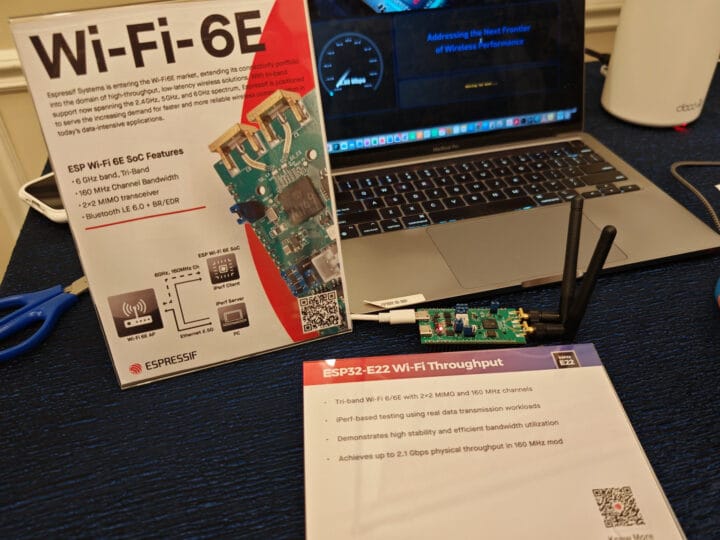
Espressif Systems showcased two new RISC-V microcontrollers at CES 2026: the high-performance ESP32-E22 Wi-Fi 6E SoC and the ultra-low-power ESP32-H21 Bluetooth LE MCU. The ESP32-E22 features a dual-core 500 MHz RISC-V CPU and tri-band Wi-Fi 6E capable of up to 2.1 Gbps throughput. Meanwhile, the battery-optimized ESP32-H21 supports Bluetooth LE and 802.15.4 (Zigbee/Thread) for wearables and sensing applications.
Report
Key Highlights
- Espressif unveiled two new RISC-V SoCs: the ESP32-E22 (high-performance Wi-Fi 6E) and the ESP32-H21 (ultra-low-power BLE/802.15.4).
- The ESP32-E22 is Espressif’s first tri-band Wi-Fi 6E chip, providing high-speed connectivity up to 2.1 Gbps.
- The ESP32-H21 is explicitly designed for extremely power-sensitive devices like IoT nodes and wearables, featuring optimized power management including an integrated DC-DC converter.
- Espressif reaffirmed commitment to its RISC-V portfolio by officially incorporating the ESP32-H4 (low-power, 802.15.4/BT 5.4 LE) for Smart Home and audio applications.
- The company's investor report hints at future development into Wi-Fi 7 and 32-bit multi-core (quad-core and above) RISC-V SoCs, slated for 2027 or later.
Technical Details
ESP32-E22 Wi-Fi 6E SoC
- CPU: Dual-core RISC-V running at up to 500 MHz.
- Wireless: Tri-band 2.4/5/6GHz Wi-Fi 6E, 160 MHz channel bandwidth, 2×2 MIMO. Supports Dual-mode Bluetooth 6.0 (LE + BR/EDR).
- Performance: Tested physical throughput reached up to 2.1 Gbps.
- Memory: 1 MB internal memory (lacks optional PSRAM).
- Host Interfaces: Supports PCIe, USB, and SDIO (when used as a co-processor).
- I/Os: 41x GPIO.
- Internal Codename: JUPITER-V1P (for the engineering sample).
ESP32-H21 Bluetooth LE MCU
- CPU: Single-core RISC-V clocked at 96 MHz.
- Wireless: Bluetooth LE and 802.15.4 (Zigbee/Thread protocols).
- Memory: 320KB RAM.
- Power Optimization: Features ultra-low-power characteristics and an integrated DC-DC converter to support low-voltage operation.
- I/Os: 19x GPIO.
- Target Use: Optimized for wearables, IoT nodes, and presence-sensing applications, positioning it against parts like the Nordic nRF5340.
Implications
- Expansion of RISC-V Portfolio: Espressif reinforces its position as a major proponent of RISC-V in the IoT sector by releasing chips covering both extreme high-speed connectivity (Wi-Fi 6E) and ultra-low-power applications (BLE/802.15.4).
- High-Speed Connectivity Adoption: The ESP32-E22 brings advanced Wi-Fi 6E capabilities (tri-band, 2.1 Gbps) into the low-cost, developer-friendly RISC-V ecosystem, challenging traditional vendors in high-throughput embedded applications.
- Competitive IoT Positioning: The ESP32-H21 directly targets the battery-powered microcontroller market, providing a RISC-V alternative to established solutions and supporting key IoT standards like Zigbee and Thread, crucial for the Matter standard.
- Future Scalability: Espressif’s roadmap commitment to Wi-Fi 7 and larger 32-bit multi-core SoCs signals continuous investment in pushing the boundaries of embedded processing and connectivity using the open RISC-V architecture.
Technical Deep Dive Available
This public summary covers the essentials. The Full Report contains exclusive architectural diagrams, performance audits, and deep-dive technical analysis reserved for our members.



